

Last updated February 15, 2026 By
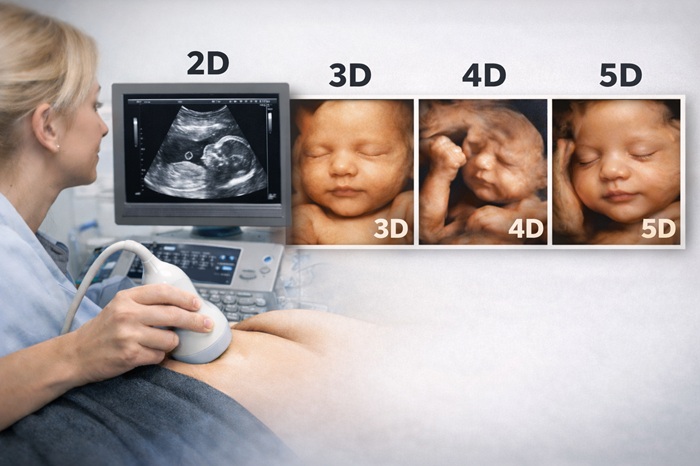
If you’re looking for a quick, clear answer: the accuracy of a gender reveal depends far more on timing and proper 2D imaging than on whether the scan is 3D, 4D, or 5D. Advanced ultrasounds mainly improve how the baby looks—not how accurately the gender can be identified. A well-performed 2D ultrasound at the right gestational age (ideally after 20 weeks) is still the most reliable method, while 3D, 4D, and 5D scans are best viewed as emotional and visual enhancements not accuracy upgrades.
| Scan Type | Main Purpose | Gender Accuracy | Best Time | Key Note |
|---|---|---|---|---|
| 2D Ultrasound | Medical diagnosis | Very High (Most reliable) | After 20 weeks | Best method for accurate gender identification |
| 3D Ultrasound | Static 3D image | Moderate | 16–24 weeks | Improves visual detail, not accuracy |
| 4D Ultrasound | Live 3D motion | Moderate | 18–26 weeks | Great emotional experience |
| 5D (HD Live) | Enhanced realistic image | Moderate | 20–28 weeks | Best for keepsake images, not medical precision |
How Ultrasound Imaging Works in Practice
All ultrasound scans operate on the same fundamental principle: high-frequency sound waves are transmitted into the body, reflected by internal structures, and converted into images. The differences between 3D, 4D, and 5D scans lie not in how the sound waves are generated, but in how the collected data is processed and presented on the screen.
It is important to remember that ultrasound machines do not “see” in the way human eyes do. They interpret echoes and construct images based on algorithms. This distinction explains why more visually realistic images do not necessarily equal better diagnostic accuracy. According to fda.gov:
Ultrasound imaging (sonography) uses high-frequency sound waves to view inside the body. Because ultrasound images are captured in real-time, they can also show movement of the body’s internal organs as well as blood flowing through the blood vessels. Unlike X-ray imaging, there is no ionizing radiation exposure associated with ultrasound imaging.
3D Ultrasound: Depth and Surface Detail
A 3D ultrasound creates a three-dimensional image by combining multiple 2D slices captured from different angles. The result is a static volumetric image that shows the baby’s surface anatomy with depth and contour. Parents are often drawn to these scans because they can clearly see facial features, hands, feet, and overall body shape.
From an emotional perspective, 3D scans are powerful. Seeing a baby’s face in three dimensions often strengthens parental attachment and makes the pregnancy feel more tangible. However, this technology focuses primarily on surface rendering, not internal anatomical precision. For gender reveal purposes, this distinction matters.
Because 3D images rely on shadows and depth perception, overlapping structures such as the umbilical cord, fingers, or folds of tissue can sometimes appear misleading. These visual effects may resemble genital anatomy even when they are not, particularly in earlier stages of pregnancy. As a result, while 3D ultrasound enhances visual clarity, it does not consistently improve gender determination accuracy.
4D Ultrasound: Real-Time Motion, Same Data
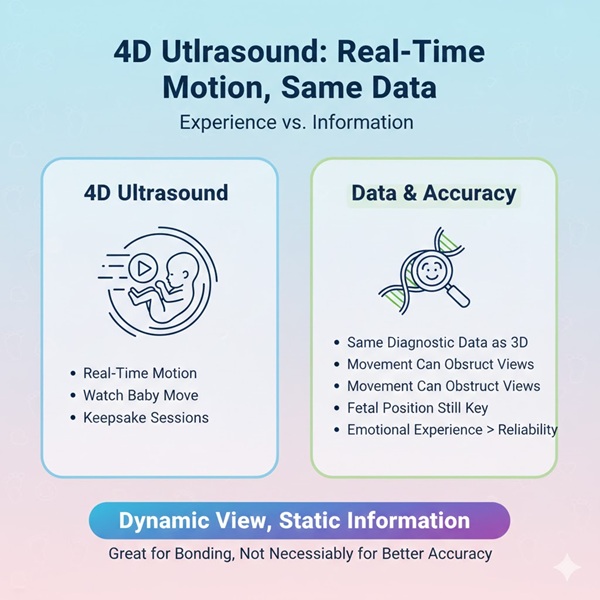
A 4D ultrasound adds the element of time to 3D imaging. Instead of a still image, parents can watch the baby move in real time—stretching, yawning, kicking, or bringing hands to the face. This live aspect often makes 4D scans a favorite choice for gender reveal events and keepsake sessions.
Despite the dynamic presentation, it is important to understand that 4D ultrasound does not introduce new diagnostic information. The underlying data remains the same as 3D imaging. The scan simply displays continuous frames instead of a single snapshot.
For gender identification, this means that while movement may help the sonographer briefly see a clearer angle, it can also create motion blur or momentary obstructions. If the fetal position is unfavorable, a 4D scan will not overcome that limitation. Therefore, the advantage of 4D lies more in emotional experience than in medical reliability.
5D Ultrasound (HD Live): Visual Enhancement, Not New Accuracy
5D ultrasound, often referred to as HD Live, represents the latest step in ultrasound visualization technology. Despite the name, it does not introduce a literal fifth dimension. Instead, it uses advanced software processing to enhance lighting, contrast, and depth simulation.
One of the defining features of 5D ultrasound is the use of a virtual light source that mimics how light falls on a face. This creates more realistic skin tones and sharper details, making images appear almost photographic. For parents seeking lifelike keepsake images, this technology can be incredibly appealing.
However, it is critical to separate image enhancement from diagnostic improvement. A 5D scan processes the same raw ultrasound data as 3D or 4D scans. It does not change how genital anatomy is captured, nor does it correct issues related to fetal position or gestational age. In other words, 5D ultrasound improves how the image looks, not what the image knows.
Why Traditional 2D Ultrasound Still Matters
Despite being less visually impressive, 2D ultrasound remains the foundation of medical imaging in pregnancy. Sonographers rely on it to identify precise anatomical planes and differentiate structures with clarity. When determining fetal sex, accuracy depends on seeing specific anatomical markers clearly and from the correct angle.
Most professionals begin every scan in 2D mode, even when a 3D or 5D session is planned. Once the correct view is confirmed, advanced modes may be used for parental viewing. Especially before the 20–22 week mark, 2D imaging often provides more reliable gender identification than surface-rendered images.
This is because 2D ultrasound reduces visual artifacts and minimizes the risk of misinterpreting shadows or overlapping tissues as genital structures.
Common Sources of Error in 3D and 4D Gender Reveals
Although advanced scans are popular, they carry certain risks when used too early or without proper expertise.
- The umbilical cord or fingers may appear similar to male genitalia in 3D-rendered images
- Temporary hormonal swelling in female fetuses can resemble male anatomy
- Shadowing and depth effects may exaggerate or obscure key details
These factors explain why some early gender reveals turn out to be incorrect, even when advanced imaging technology is used.
Timing: The Most Important Factor in Gender Reveal Accuracy
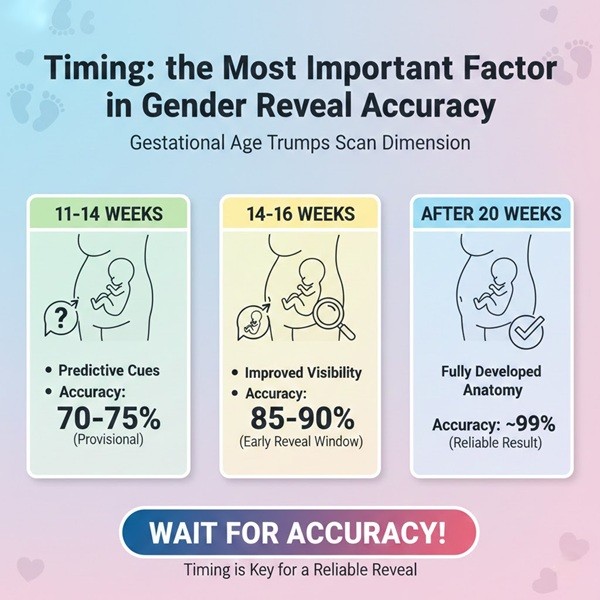
The accuracy of a gender reveal depends far more on gestational age than on whether the scan is 3D, 4D, or 5D.
- 11–14 weeks: Gender determination at this stage is largely predictive and based on subtle anatomical cues. Accuracy is typically around 70–75 percent, and results should be considered provisional.
- 14–16 weeks: Visibility improves significantly, with accuracy reaching approximately 85–90 percent under optimal conditions. Many parents choose this window for early gender reveal sessions, understanding there is still a margin of error.
- After 20 weeks: Genital anatomy is fully developed and clearly visible. Accuracy approaches 99 percent, regardless of the scan dimension used.
Waiting until the appropriate stage of pregnancy is the single most effective way to ensure a reliable gender reveal.
External Factors That Affect Scan Quality
Even with advanced equipment, several variables can influence the clarity and success of a gender reveal scan. Fetal position plays a major role; if the baby is crossing their legs or facing away, visibility may be limited regardless of scan type. Maternal body composition can also affect image quality, as ultrasound waves must travel through tissue before reaching the fetus. Additionally, sufficient amniotic fluid is essential for creating a clear acoustic window.
These factors explain why two scans performed with the same machine can produce very different results.
Emotional Experience Versus Medical Reliability
One of the most important distinctions for parents to understand is the difference between how a scan feels and how accurate it is. Advanced scans excel at creating emotional connection and memorable images, while traditional imaging excels at precise identification.
The most effective gender reveal experience often combines these strengths: accurate confirmation using 2D ultrasound, followed by 3D, 4D, or 5D imaging for celebration and keepsake purposes.
Safety and Choosing a Reputable Provider
Ultrasound is widely considered safe when performed by trained professionals for appropriate medical reasons. However, experts caution against unregulated “boutique” ultrasound centers that offer prolonged 3D or 4D sessions without proper medical oversight. Any gender reveal scan should be conducted by qualified and registered personnel who understand both fetal anatomy and safety guidelines.
Gender Reveal for Twins or Multiple Pregnancies
Gender reveal scans in twin or multiple pregnancies are naturally more challenging than in singleton pregnancies. With more than one fetus sharing limited space, overlapping positions and restricted visibility are common. This can make it difficult to obtain a clear view of each baby’s genital anatomy, even when using advanced 3D, 4D, or 5D ultrasound technology.
In these cases, accuracy depends less on the type of scan and more on careful identification and experience. Sonographers typically rely on 2D imaging first to distinguish each fetus clearly before confirming findings. For this reason, parents expecting twins or multiples are often advised to wait until later gestational weeks, when fetal separation and anatomical visibility improve, reducing the risk of confusion or error.
Cost vs Value: Are Advanced Scans Really Worth It?
Advanced ultrasound scans such as 3D, 4D, and 5D often come with higher costs, leading many parents to question whether they offer real value for gender reveal. From a medical standpoint, these scans do not significantly increase the accuracy of gender determination compared to a well-performed 2D ultrasound at the right stage of pregnancy.
However, their value lies mainly in the emotional experience they provide. Lifelike images and real-time movement can make the moment more memorable and meaningful for parents. When expectations are realistic and focused on experience rather than guaranteed accuracy, advanced scans can be worthwhile. The key is understanding that higher cost reflects enhanced visuals, not improved diagnostic certainty.
Final Answer: Which Scan Is Really Better for Gender Reveal?
There is no single “best” scan for every purpose.
2D ultrasound remains the most reliable method for determining fetal sex, particularly earlier in pregnancy.
3D and 4D scans enhance emotional connection and visual engagement but do not guarantee higher accuracy.
5D ultrasound offers the most lifelike images yet does not improve gender determination beyond what skilled 2D imaging already provides.
The best choice depends on your priorities: accuracy, experience, or visual keepsakes. Understanding the role of each technology allows parents to make informed, realistic decisions.
Frequently Asked Questions
- Is 3D or 4D ultrasound more accurate than 2D for gender reveal?
No. Despite their advanced appearance, 3D and 4D ultrasounds are not more accurate than 2D ultrasound for determining fetal gender. Accuracy depends mainly on gestational age, fetal position, and the skill of the sonographer, not on image dimension.
- Can 5D ultrasound guarantee a correct gender result?
No. 5D (HD Live) ultrasound improves image realism through enhanced lighting and contrast, but it does not provide additional anatomical information. Gender accuracy is the same as 2D, 3D, or 4D scans when performed at the same stage of pregnancy.
- What is the earliest week gender can be identified by ultrasound?
Gender may be predicted as early as 11–14 weeks, but accuracy at this stage is limited (around 70–75%). Results before 16 weeks should always be considered provisional.
- When is ultrasound gender determination most accurate?
After 20 weeks of pregnancy, when genital anatomy is fully developed and clearly visible. At this stage, accuracy approaches 99%, regardless of whether the scan is 2D, 3D, or 5D.
- Why do some early gender reveals turn out to be wrong?
Early scans are prone to error due to fetal position, temporary genital swelling, umbilical cord interference, and shadowing—especially in 3D or 4D images where depth effects can be misleading.