


Last updated February 15, 2026 By
Obsessive interest in early fetal gender determination is primarily psychological rather than medical. Knowing the baby’s sex gives parents a sense of certainty, emotional connection, and control during an otherwise uncertain stage of pregnancy. However, in early gestation the fetus has not yet developed clear sexual characteristics, making both ultrasound and early blood tests prone to error. The stronger the emotional need for early certainty, the higher the risk of misinterpretation and later emotional distress.
| What parents want to know | Fast answer | Most reliable method | When it’s reasonably reliable | Common reasons it goes wrong | Best next step |
|---|---|---|---|---|---|
| Can I know the baby’s sex very early? | Sometimes, but early results are easier to get wrong. | NIPT (blood test) + confirm later by ultrasound | NIPT: after ~10 weeks (often more reliable). Ultrasound: later in pregnancy. | Low fetal DNA early, lab/biological edge cases, misread ultrasound images. | Treat early results as “likely,” not “certain,” until confirmed. |
| Is early ultrasound accurate? | Not reliably in the first trimester. | Second-trimester anatomy ultrasound | Generally much better after the first trimester. | Fetal position, movement, angle of genital tubercle, look-alike anatomy. | Wait for a later scan if accuracy matters to you. |
| Is NIPT “100%” for sex? | No—highly accurate when timed correctly, but not perfect. | NIPT done at the recommended gestational age | Usually after ~10 weeks (depends on provider/lab guidance). | Vanishing twin, rare maternal factors, low fetal fraction, contamination (rare). | If results matter a lot, confirm with follow-up imaging/testing. |
| Why do people become so focused on it? | It reduces uncertainty and helps bonding—but can create rigid expectations. | Emotional awareness + flexible mindset | Any time in pregnancy. | Confirmation bias, stereotypes (“gender essentialism”), social media pressure. | Focus on health milestones first; keep gender expectations open. |
| What happens if the early result is wrong? | It can feel surprisingly upsetting and embarrassing. | Clear communication + re-framing | Whenever a correction happens. | Early attachment to a “boy/girl” story, public announcements, family pressure. | Normalize the reaction; update plans after confirmation. |
| When is early sex determination medically important? | When there’s a risk of sex-linked genetic conditions. | Clinician-guided testing plan | As recommended by a specialist. | Rushing tests without confirmatory steps. | Follow medical guidance; use confirmatory diagnostics when advised. |
| How can I avoid “gender obsession”? | Watch for anxiety-driven urgency and repeated testing. | Set a “confirmation point” (a later scan) before announcing. | Before sharing publicly. | Turning “maybe” into “definitely,” pressure from others. | Delay announcements; treat early info as provisional. |
The Emotional Roots of Gender Obsession During Pregnancy
One of the strongest drivers behind early gender scanning is emotional bonding. For many parents, knowing the baby’s sex transforms an abstract pregnancy into a more concrete, personal experience. Once the fetus is labeled “son” or “daughter,” parents often feel closer, more connected, and more prepared.
This emotional shift allows parents to choose names, imagine future milestones, and begin practical preparations such as decorating a nursery or buying clothes. While this bonding can be positive, it also creates a powerful emotional incentive to seek certainty as early as possible—even when medical accuracy is not yet guaranteed.
In this context, gender becomes a psychological anchor. Parents are not simply asking a biological question; they are seeking reassurance, identity, and emotional clarity during an inherently uncertain period.
Parenting Fantasies and Gender Essentialism
Another major factor influencing gender obsession is gender essentialism—the belief that biological sex determines personality traits, interests, and life paths. Many parents, consciously or unconsciously, associate specific dreams with having a boy or a girl.
These expectations may include imagined activities, hobbies, or family roles, such as sports for boys or artistic pursuits for girls. While modern parenting discourse increasingly challenges these stereotypes, they remain deeply embedded in cultural narratives and personal upbringing.
When parents carry strong gender-based fantasies into pregnancy, the desire for early confirmation intensifies. In such cases, gender scans are not simply informational tools; they become instruments used to validate pre-existing hopes. This emotional investment increases the likelihood of selective interpretation, where ambiguous signs are read in ways that align with expectations rather than biological evidence.
Social Media, Performance, and the Rise of Gender Reveal Culture
In the digital age, pregnancy has become a public experience. Social media platforms encourage parents to document and share every milestone, and gender reveal events have evolved into highly visible performances of parenthood.
These events often function as symbolic announcements of identity, family values, and social status. Elaborate reveals, themed parties, and professionally produced videos reflect not only excitement but also participation in a broader culture of conspicuous consumption.
Under these conditions, early gender determination becomes socially rewarding. The pressure to announce, celebrate, and display certainty encourages parents to trust early tests or scans, even when medical professionals emphasize uncertainty. Once a gender is publicly declared, reversing it becomes emotionally and socially difficult, increasing resistance to later corrections.
Cultural and Economic Pressures in Gender Preference
In some societies, particularly parts of East and South Asia, gender obsession is further intensified by cultural and economic factors. A longstanding preference for sons is often tied to inheritance traditions, family lineage, and expectations of financial support in old age.
In these contexts, early gender determination may carry significant emotional weight, influencing family dynamics and parental behavior long before birth. Even when parents personally reject such preferences, extended family expectations can exert subtle pressure, increasing anxiety around early results.
These pressures can amplify confirmation bias, where ambiguous findings are interpreted optimistically rather than accurately, especially if they align with cultural expectations.
Legitimate Medical Reasons for Early Gender Determination
It is important to acknowledge that not all interest in early gender testing is rooted in emotion or social pressure. In certain medical situations, early sex determination is clinically necessary.
Families with a history of X-linked genetic disorders, such as Duchenne muscular dystrophy, may need to know fetal sex early to determine whether invasive diagnostic testing is required. In these cases, accuracy and timing are critical, and testing is approached with medical caution rather than emotional urgency.
However, even in medically justified scenarios, healthcare providers emphasize confirmatory testing and careful interpretation, underscoring the inherent limitations of early methods.
Biological Reality: Why Early Gender Identification Is Difficult
From a biological standpoint, early pregnancy is a period of developmental neutrality. During the first trimester, male and female fetuses share nearly identical external genital structures. Both possess a structure known as the genital tubercle, which later differentiates into male or female genitalia.
At this stage, visual differences are minimal and highly variable. A slightly pronounced tubercle in a female fetus can easily be mistaken for male anatomy, particularly when viewed from limited angles. This anatomical similarity makes early ultrasound-based gender determination inherently unreliable.
Technical Limitations of Ultrasound Technology
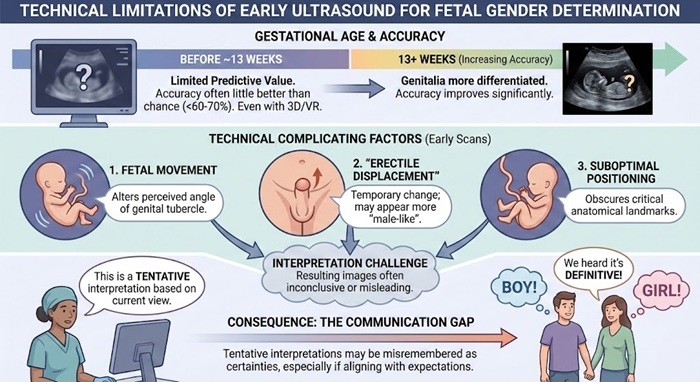
Ultrasound accuracy is highly dependent on gestational age. Before approximately 13 weeks, even advanced imaging techniques such as 3D or virtual reality ultrasound have limited predictive value. Studies indicate that accuracy rates before this point may be little better than chance.
Several technical factors further complicate interpretation:
- Fetal movement during the scan can alter the perceived angle of the genital tubercle.
- Temporary “erectile displacement” may cause the tubercle to appear more male-like.
- Suboptimal fetal positioning can obscure critical anatomical landmarks.
As a result, sonographers may provide tentative interpretations that are later remembered by parents as definitive statements, especially when those interpretations align with expectations.
How Expectations Distort Interpretation
Once parents emotionally invest in a particular outcome, perception changes. Ambiguous images are no longer neutral data; they become evidence supporting a desired conclusion. This psychological process, often referred to as confirmation bias, plays a significant role in early gender misidentification.
Parents may selectively remember confident-sounding phrases while overlooking caveats, or reinterpret uncertain language as confirmation. Over time, the expectation hardens into perceived fact, even in the absence of reliable evidence.
Blood Tests and the Illusion of Early Certainty
Non-invasive prenatal testing (NIPT) is often perceived as more accurate than ultrasound because it is based on DNA analysis. While NIPT is highly reliable when performed correctly and at the appropriate time, it is not immune to error—particularly when expectations push testing too early.
Several biological and technical factors can compromise NIPT accuracy:
- In cases of a vanishing twin, residual male DNA may persist in the mother’s bloodstream, leading to a false male result even if the surviving fetus is female.
- Rare instances of maternal mosaicism can introduce Y-chromosome material unrelated to the current fetus.
- Testing before 10 weeks may result in insufficient fetal DNA, increasing the risk of false negatives.
- Laboratory contamination with male DNA, though uncommon, can produce false-positive results.
Despite these known limitations, parents often treat early blood test results as definitive, reinforcing expectations prematurely.
The Consequences of Early Misidentification
When early gender determination proves incorrect, the emotional impact can be significant. Parents may experience disappointment, confusion, or even guilt for feeling attached to an imagined identity that no longer applies.
In some cases, families delay acceptance of corrected results, insisting that earlier tests must have been right. This resistance illustrates how deeply expectations can override objective evidence once emotional bonds have formed.
Why Waiting Improves Accuracy and Emotional Wellbeing
From both a medical and psychological perspective, waiting until biological differentiation is clearly visible significantly improves accuracy and reduces emotional distress. Later ultrasounds, performed after the first trimester, provide near-certain results because anatomical differences are fully developed.
More importantly, delaying gender determination allows parents to focus on overall fetal health rather than fixating on a single characteristic. This shift encourages a more flexible, less expectation-driven relationship with the pregnancy.
A Developmental Metaphor: Seeing the Future Too Soon
Attempting to determine fetal sex too early is comparable to identifying a plant by its first identical leaves. At that stage, all seedlings look the same. While imagination may already picture flowers or fruit, the biological reality has not yet declared itself.
Environmental factors—movement, angle, testing conditions—can easily distort perception, leading observers to see what they hope for rather than what truly exists.
The Psychological Impact of Getting It Wrong
Why a wrong gender result feels bigger than “just a mistake”
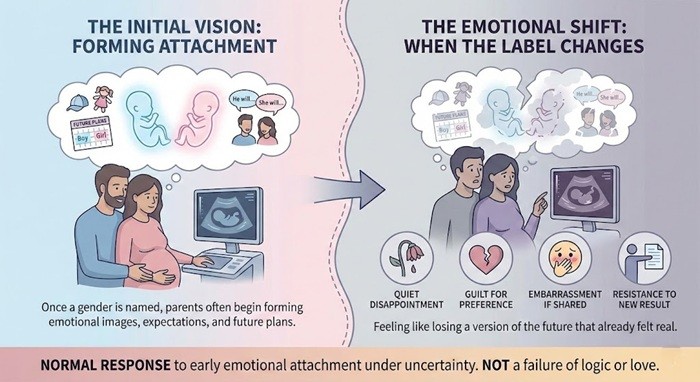
When an early gender scan turns out to be wrong, many parents are surprised by how strongly it affects them. This is because the result was never just medical information. Once a gender is named, parents often begin forming emotional images, expectations, and future plans around it.
Even in a short time, the label “boy” or “girl” can shape how parents talk about the baby, imagine their personality, or picture daily life ahead. When that label changes, it can feel like losing a version of the future that already felt real.
Common emotional reactions include:
- A sense of quiet disappointment that feels hard to explain
- Guilt for having preferred or imagined one outcome
- Embarrassment if the result was shared with others
- Resistance to accepting the corrected result, even when it is more accurate
These reactions are not a failure of logic or love. They are a normal response to early emotional attachment formed under uncertainty.
Gender Disappointment vs Gender Obsession
Knowing when curiosity turns into pressure
Feeling curious about a baby’s sex is normal. Feeling slightly disappointed is also human. The problem begins when curiosity turns into fixation and the pregnancy experience starts revolving around one outcome.
Gender disappointment is usually brief and self-aware. Parents recognize their feelings, adjust, and move forward.
Gender obsession, however, is driven by anxiety and rigid expectations.
Signs that interest may be crossing into obsession include:
- Repeated early scans or tests despite uncertain accuracy
- Strong emotional reactions to ambiguous results
- Difficulty enjoying the pregnancy without gender certainty
- Interpreting “maybe” or “likely” as definitive answers
When expectations become this intense, accuracy suffers—not because technology fails, but because perception becomes biased. Letting go of early certainty often leads to a calmer pregnancy and more reliable information later.
Conclusion: Balancing Curiosity With Reality
Parental obsession with gender scans is rooted in understandable emotional, cultural, and social motivations. However, when expectations outpace biology, accuracy suffers. Early testing—whether via ultrasound or blood analysis—operates within real limitations that cannot be overcome by desire or technology alone.
Recognizing these limitations allows parents to approach gender determination with curiosity rather than urgency, and with openness rather than certainty. In doing so, they protect not only the accuracy of results but also their emotional experience of pregnancy itself.
Ultimately, patience remains the most reliable tool in prenatal gender identification—offering clarity, accuracy, and peace of mind when the time is truly right.
Frequently Asked Questions
- Why do parents feel so anxious to know the baby’s sex early?
Because knowing the baby’s sex reduces uncertainty and helps parents emotionally connect, imagine the future, and feel more in control during early pregnancy. This emotional comfort often outweighs concerns about medical accuracy.
- Is early gender determination medical or emotional?
In most cases, it is emotional rather than medical. While there are legitimate medical reasons in specific situations, most early testing is driven by bonding, expectations, and anxiety—not clinical necessity.
- How accurate is early ultrasound for determining fetal sex?
Early ultrasound, especially in the first trimester, is not very reliable. Male and female fetuses look anatomically similar at this stage, making misidentification common.
- Is NIPT completely reliable for fetal sex?
No. NIPT is highly accurate when done at the correct time, but it is not perfect. Early testing, low fetal DNA, vanishing twins, or rare biological factors can lead to incorrect results.
- Why do early results get misinterpreted so often?
Because expectations influence perception. When parents strongly want a specific result, ambiguous images or cautious language may be remembered as confirmation rather than uncertainty.
- What is gender essentialism and how does it affect pregnancy?
Gender essentialism is the belief that biological sex determines personality and life outcomes. During pregnancy, it can intensify the desire for early confirmation and fuel rigid expectations about the child.